
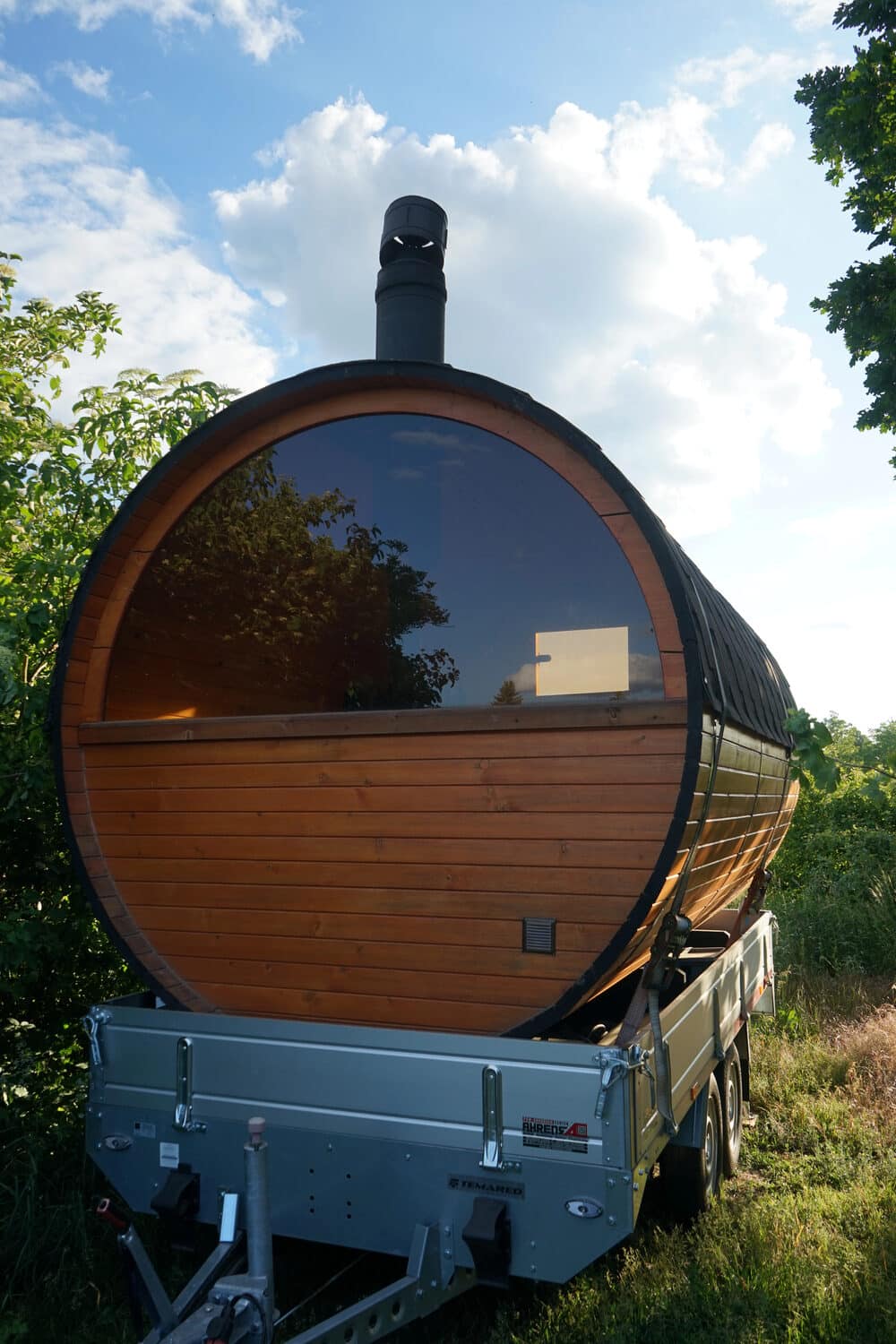
A garden sauna used to mean a chunky log cabin at the bottom of a long lawn. Most of us don’t have that kind of space, and the wrong model can swallow half a patio before you’ve even added a bench. Outdoor saunas for small backyards have come a long way, though, with cubes, micro-barrels and slimline cabins that sit on around 2m² of ground. Here are eight things worth measuring up for, plus what to check before you order.
What makes a sauna work in a small garden
The number on the product page is only half the story. A sauna that measures 1.5m x 1.3m still needs space around it for air to circulate, for the door to open and for you to get round the back to treat the timber once a year. In a tight garden, those extra centimetres decide whether it fits or not.
A few things matter more than seat count when space is short:
- Shape. Cubes and slim cabins sit flush against a fence. Barrels need room for their curve and usually a cradle or base frame underneath.
- Height. Anything within 2m of a boundary in England has to stay under 2.5m tall to avoid a planning application, so a low roofline is useful.
- Power supply. Most proper outdoor saunas need a dedicated hardwired circuit, and a longer cable run from the house adds cost.
- Weight. Compact units still weigh 450-600kg empty, so the base matters as much as the sauna itself.
- Delivery route. Flat-pack boxes can run over 2m long. If your only access is a narrow side gate, check the box size before you choose the colour.
The 8 best outdoor saunas for small backyards
1. Polar Recovery Sauna Cube Mini
Cube saunas are now the preferred shape for smaller gardens, as their flat walls fit neatly against a fence and their simple roof design maximises headroom. Thermowood ranges like the Polar Recovery Sauna Cuba demonstrate how far the format has shrunk, with the Mini version measuring 167cm wide, 120cm deep and 216cm tall. That’s roughly 2m² of ground for a proper two-person sauna with a Harvia Vega 3.5kW stove and stones you can ladle water onto.
The shell is made from thermally treated Finnish wood with 45mm walls, and the benches are alder, which remain more comfortable to sit on at high temperatures than many softwoods. You can choose a wooden front if the sauna faces the neighbours, or a glass front if it looks out over your own garden. If you want room for friends, the 3-5 person Cube in the same range stretches to 205cm x 160cm and has a 6kW heater.
Like every stove-heated sauna on this list, it needs its own supply (32A here). Adding a new circuit is notifiable electrical work under the Building Regulations, so budget for a registered electrician from the start.
At a glance: 167 x 120 x 216cm | 2 people | 3.5kW Harvia Vega | 32A supply | from £4,699.99 (glass front £5,499.99)
2. InMedias Sauna Icon 125
Most small gardens are long and narrow rather than square, and that’s where a shallow cabin earns its place. Slimline designs such as the InMedias Icon 125 are only 125cm deep, so they can run along a boundary fence and leave most of the lawn free.
Inside, you get around 5m³ of space for two or three people, thermowood walls, thermo-aspen benches and a full glass front. It works with electric heaters (Harvia 6kW or 8kW, or a HUUM Drop 6kW with Wi-Fi) or a wood-burning stove, which is useful if getting power to the end of the garden is a headache. The retailer quotes a heat-up time of 30-40 minutes.
At a glance: 205 x 125 x 210cm | 2-3 people | electric or wood-burning | from £3,431 before heater
3. Finnmark Thermo Wood Barrel Micro
Barrels are the classic garden sauna shape, but standard models run to 2-3m long. The micro versions solve that. Finnmark’s Micro barrel is just 149cm long with a 190cm diameter, giving 3.5m³ of room for two people.
The curved roof means there’s less empty air above the benches to heat, and it sheds rain well. The timber is 40mm Nordic thermo spruce with thermo-aspen benches and flooring, and the heater option is a HUUM Drop 6kW with a Wi-Fi controller.
The catch is that it is 190cm width. A barrel needs room for its curve, so it takes up more ground than a cube with similar seating. It suits gardens that are short but reasonably wide.
At a glance: 149 x 190 x 204cm | 2 people | 6kW electric option | hardwired | £3,995
4. CenturaHeat 2 Person Steam Outdoor Sauna House
If your space is measured in paving slabs rather than metres, this model is the one to look at. At 120cm wide and 105cm deep, it takes up just 1.26m², which is small enough for a corner of a patio or the end of a narrow terrace garden.
It’s built from Canadian hemlock and heated by a 3kW electric stove, with a temperature range of 18-99°C. Controls are more gadget-friendly than most traditional saunas, with an app, an onboard panel, Bluetooth audio and LED lighting.
The trade-off is height. At 230cm it’s one of the taller models here, so if it’s going within 2m of a fence, check that your base doesn’t push the total over 2.5m. It needs hardwiring on a dedicated 16A circuit rather than plugging into an outdoor socket.
At a glance: 120 x 105 x 230cm | 2 adults | 3kW stove | 16A hardwired | £2,599 (RRP £3,060)
5. Finnmark Thermo Wood Cube Mini
This cube is slightly narrower than the Polar Mini but a touch deeper, at 145cm x 133cm. It’s built from 40mm thermally modified spruce, with a two-tier aspen bench and 8mm tempered glass on the door and front walls, which makes a small cabin feel far less boxy from the inside.
It arrives as a complete DIY kit in a single box measuring 78 x 209 x 111cm, so measure your side gate before anything else. You can buy it without a heater or pair it with a 6kW Narvi or HUUM unit. The 6kW option heats a space this size quickly, but it needs a dedicated 32A circuit.
At a glance: 145 x 133 x 221cm | 1-2 people | 6kW electric options | 32A supply | £4,993.99 without heater
6. CenturaHeat 3 Person Outdoor Infrared Sauna
Infrared saunas warm your body directly with heated panels rather than heating the air, so they run at a gentler 18-65°C. If you find a traditional 80°C+ sauna hard going, this style is easier to sit in for longer.
This model fits three people into a 150cm x 110cm footprint, which is an impressive capacity for 1.65m² of ground. It uses carbon fibre panels with a total rating of 3.5kW and runs off a dedicated 16A circuit, which is less demanding than the 32A that most stove-heated cubes need. Extras include app control, Bluetooth and LED reading lights.
You won’t get the steam and heat of water on hot stones, which is what some people want. Think of it as a different experience rather than a smaller version of the same thing.
At a glance: 150 x 110 x 230cm | 3 people | 3.5kW infrared | 16A hardwired | £2,569 (RRP £3,171)
7. Hiki S Premium Thermowood
The Hiki S is for anyone who wants a cabin that looks designed rather than delivered. At 150cm x 202cm it’s bigger than the cubes above but still compact enough for a modest garden, and the finish is a clear step up.
The walls and roof are 40mm thermowood, the floor and decking 28mm thermowood, and the two-level thermo-aspen benches have built-in backrests, which makes a long session far more comfortable. Bronze tempered glass on the door and window adds privacy without blocking the light. A 6.6kW heater is included and needs hardwiring on a dedicated circuit.
At a glance: 150 x 202 x 216cm | 2-3 adults comfortably | 6.6kW electric | hardwired | around £9,130 on offer (RRP £10,741)
8. Saunum Classic Mini
At £15,999 this unit is the most expensive model here, and at 210cm x 186cm it’s also the largest. It makes the list because it’s the lowest, at under 197cm tall, which gives you the most flexibility near a boundary, and because it feels more like a small garden room than a hut.
The exterior is anthracite thermo-spruce with an alder interior, mineral wool insulation and double-glazed tempered windows. There’s mechanical ventilation, LED lighting behind the backrest and under the bench, built-in Bluetooth speakers and a PVC roof with a rainwater gutter. Assembly is minimal.
At a glance: 210 x 186 x 197cm | 2-3 people | electric | £15,999 with UK delivery
How to measure your garden before you buy
Measure the footprint, then add clearance. Manufacturers such as Finnmark suggest leaving 30-50cm on every side for airflow and maintenance, so a 150cm x 130cm cube really needs something closer to 230cm x 210cm. Add the swing of the door on top of that, plus a spot to hang a towel or stand to cool off.
Next, walk the delivery route. Flat-pack boxes for compact saunas run to around 2m long and over 1m wide, and some units arrive partly assembled. Measure any side gates, alleyways and tight corners.
Then think about how you’ll actually use the space. A sauna tucked behind the shed might save room, but you’ll be walking to it in the dark in January. If you’re planning the rest of the garden around it, our ideas on maximising your family garden space all year round help you balance a new feature with play space, storage and seating. Make sure there is enough room to move around the area comfortably.
Choosing a base
Most compact saunas weigh 450-600kg empty, before anyone sits inside. The usual options are:
- Concrete slab. This is the most solid choice and the best option for heavier cubes.
- Paving slabs on a compacted sub-base. Fine if the patio is already level and well laid.
- Compacted gravel with timber bearers. Cheaper, drains well, and is often enough for smaller cabins.
Whatever you pick, it must be level. A sauna that sits out of true puts strain on the door and joints and can let water in.
Do you need planning permission for a garden sauna?
In most cases, no. In England, a garden sauna usually counts as an outbuilding under permitted development. The rules for outbuildings allow a maximum height of 2.5m for any building within 2m of a boundary. Further from the boundary, you can go up to 4m with a dual-pitched roof or 3m with any other roof.
Every model on this list is under 2.5m tall before you add a base, so all of them can sit close to a fence. Just remember that a raised base adds to the overall height.
A few other rules apply:
- The sauna can’t be placed in front of the house.
- Outbuildings and extensions can’t cover more than half the land around the original house.
- Conservation areas, National Parks, Areas of Outstanding Natural Beauty and listed buildings carry extra restrictions.
Wales, Scotland and Northern Ireland have their own rules, so check with your local planning authority if you live outside of England. Small detached outbuildings under 15m² without sleeping accommodation are generally exempt from Building Regulations, but the electrical work isn’t.
Power, heat-up time and running costs
The supply your sauna needs affects both the install cost and where it can go.
- 16A circuit. Enough for smaller stoves around 3kW and most infrared cabins, like both CenturaHeat models here.
- 32A circuit. Needed for 6kW stoves and above, which covers most thermowood cubes and barrels.
- Wood-burning. No mains power at all, which suits gardens where running a cable is awkward. You’ll need to think about the flue, smoke drifting towards neighbours and whether you live in a smoke control area.
The further the sauna sits from your consumer unit, the thicker the cable needs to be, which pushes up the cost. That’s one reason placing it closer to the house can save money as well as a cold walk.
As for running costs, a heater’s rating tells you the most it can draw. A 6kW stove running flat out for an hour uses 6kWh, but once the room reaches temperature, the thermostat cycles the elements on and off, so a real session uses less. At a unit rate of around 25p per kWh, even an hour at full power costs about £1.50. Smaller 3kW and 3.5kW units cost roughly half that.
Traditional, infrared or barrel in a small space
Each style suits a different kind of small garden and a different kind of sauna user.
Traditional cube or cabin saunas give you the Finnish experience of high heat, hot stones and steam. They use space most efficiently, because flat walls and square benches mean nothing is wasted. Most of the research on sauna health is based on this type. A long-running Finnish study published in JAMA Internal Medicine followed 2,315 middle-aged men for a median of about 20 years and found that those who used a sauna 4-7 times a week had a 50% lower risk of fatal cardiovascular disease than those who went once a week. It shows an association rather than proof of cause, but it’s why so many people want a sauna they can use every day rather than once a month at the gym.
Barrel saunas heat efficiently and look great, but the curve costs you floor space. Choose a micro barrel only if you have the width.
Infrared cabins are the easiest on power and run cooler, which makes them a good fit for people who find traditional heat too intense. They can also squeeze more seats into a small footprint.
Looking after a sauna outdoors
Thermowood is stable and resists rot, but it still needs care. Treat the exterior with a breathable wood product once a year (some warranties require it), never a sealant that traps moisture. Check the roof shingles after winter storms, clear leaves from the roof and base, and keep vents free.
Inside, sit on a towel to keep sweat off the benches and leave the door open after each session so the wood dries out. A soft brush and warm water are enough for the benches, and glass fronts need wiping regularly to stay clear.
A sauna also looks better when it feels part of the garden rather than dropped into it. Soft lighting, a couple of planters and somewhere to sit and cool down make a big difference, and the ideas in these effortless ways to turn your garden into a cosy sanctuary work just as well around a sauna. Choose plants and furniture that can handle the outdoor conditions.
Frequently Asked Questions
How much space do I need for an outdoor sauna?
The smallest two-person saunas need around 1.3-2m² of ground, plus 30-50cm of clearance on each side. In practice, allow about 2m x 2m for a compact cube once you include door swing and access. Barrels need more width for the same seating.
What is the smallest outdoor sauna you can buy?
Among full outdoor cabins, the CenturaHeat 2 Person Steam Outdoor Sauna House is one of the smallest, at 120cm x 105cm. Smaller portable tents and pop-up saunas exist, but they’re not built to stay outdoors all year.
Do I need planning permission for a garden sauna in the UK?
Usually not in England, as long as the sauna meets permitted development rules for outbuildings. It must stay under 2.5m tall if it’s within 2m of a boundary and can’t sit in front of the house. Extra limits apply in conservation areas, National Parks and to listed buildings.
Can an outdoor sauna run off a normal plug socket?
Not the models on this list. Outdoor saunas with a stove or powerful infrared panels need a dedicated hardwired circuit, usually 16A or 32A. A registered electrician should install it, as a new circuit is notifiable work.
How much does it cost to run an outdoor sauna?
A 6kW heater uses at most 6kWh per hour, which is about £1.50 at 25p per kWh. Real-world use is lower because the thermostat cycles the heater once the room is hot. Smaller 3kW stoves and infrared cabins cost roughly half that.
Is a barrel or cube sauna better for a small garden?
A cube is usually better for small gardens because its flat walls sit flush against a fence and use floor space more efficiently. Barrels need extra width for their curved shape. A micro barrel works well if your garden is short but reasonably wide.
Are infrared saunas good for small spaces?
Yes, infrared cabins fit more seats into a small footprint and often run on a 16A supply rather than 32A. They run at lower temperatures of around 18-65°C. You won’t get steam from water on stones, though.
What base does an outdoor sauna need?
An outdoor sauna needs a level, solid and well-drained base. A concrete slab is the strongest option, while paving on a compacted sub-base or compacted gravel with timber bearers works for many compact models. Compact saunas typically weigh 450-600kg before anyone steps inside.
How close to the fence can I put a sauna?
In England, you can place a sauna right up to the boundary as long as it’s no taller than 2.5m within 2m of the fence. Leave 30-50cm of space behind it for airflow and so you can treat the timber. Check your deeds for any restrictive covenants too.
Can you use an outdoor sauna in winter?
Yes, winter is when many people use them the most. Well-insulated thermowood cabins handle cold weather well, though they take a little longer to heat up. Keep the roof clear of heavy snow and leaves.
How long does an outdoor sauna last?
A well-maintained thermowood sauna can last 15 years or more, which is the lifespan InMedias quotes for its cabins. Annual exterior treatment, a sound roof and a well-drained base make the most significant difference. Letting the interior dry after each use helps prevent mould and rot.
Final thoughts
The best outdoor sauna for a small backyard is the one that fits with room to breathe, not the one with the most seats. Start with your measurements, add clearance, check your delivery route and power supply, then choose between a cube, a micro barrel or an infrared cabin based on how you like to use a sauna. Get those basics right, and even a tiny garden has space for a sauna you’ll use all year.